
Schrannenplatz Grain Markets and Public Executions 1700, 1853
For over one hundred and fifty years of the period in question, the heart of Munich did not answer to the name Marienplatz. From the medieval era until the mid-19th century, this urban node was Schrannenplatz, a title that stripped away religious affectation to reveal its primary function: the logistical engine of the city's caloric survival. The square was not a destination for leisure, nor a backdrop for selfies, a gritty, unpaved theatre of commerce and state-sanctioned violence. Its dual purpose was absolute. It fed the population through the grain exchange, or Schranne, and it disciplined the population through the public spectacle of the scaffold.
The economics of Schrannenplatz were dictated by the biology of the city. Munich in the 18th century remained a of consumption surrounded by an agrarian hinterland. The square functioned as the central nervous system for the grain trade, specifically wheat, rye, and oats. Every farmer entering the city gates was funneled here, their wagons weighed and inspected under the strict supervision of municipal authorities. The Schranne was not a free market in the modern sense; it was a highly regulated exchange where prices were fixed to prevent the riots that inevitably followed bread absence. The magistracy understood that the distance between a hungry populace and a violent insurrection was measured in the price of a bushel of rye.
Historical data from the period indicates that grain prices in Munich were less integrated with international markets than those in northern German cities like Hamburg or Cologne. While the north fluctuated with the pulse of the Atlantic trade, Schrannenplatz prices remained tethered to the local harvest pattern of Upper Bavaria. A wet summer in the hinterlands spelled immediate inflation on the square. During the famine years of the 1770s, the mood in Schrannenplatz shifted from mercantile bustle to desperate agitation. The Mariensäule, erected in 1638, stood in the center of this chaos. It is a grim irony that one of the four bronze putti at the column's base depicts a child battling a dragon representing Famine. For decades, the traders and buyers of Schrannenplatz haggled over wheat futures directly beneath a monument explicitly dedicated to the fear of starvation.
The architecture of the square prior to 1853 bore little resemblance to the neo-Gothic grandeur of the New Town Hall, which would not break ground until 1867. Instead, the space was defined by the utilitarian structures of the market and the medieval Old Town Hall (Altes Rathaus). The ground was frequently a slurry of mud, horse manure, and discarded husks, a sanitary nightmare that predated modern sewage systems. In this filth, the city's judicial operated with brutal efficiency. The square served as the primary site for public executions, a practice that transformed the marketplace into a stage for the performance of sovereignty.
The most notorious of these executions occurred on March 17, 1706. The victim was Matthias Kraus, a butcher by trade and a leader of the Bavarian People's Uprising against the Austrian occupation. The rebellion had culminated in the disastrous "Sendlinger Mordweihnacht" (Sendling Night of Murder) on Christmas 1705, where over a thousand peasant insurgents were slaughtered by imperial troops. Kraus, having been captured and tortured, was brought to Schrannenplatz to serve as a warning to the citizenry. The executioner did not kill him; the sentence demanded he be beheaded and then quartered. His body parts were subsequently displayed at the city gates. This bloodshed occurred in the same physical space where housewives purchased their daily flour, reinforcing the state's power to control both the biological means of life and the physical instrument of death.
The executioner, or Scharfrichter, was a familiar figure in the district, frequently residing near the city walls performing his duties in the center. The pillory, or Pranger, stood on the square as a site for lesser punishments. Petty criminals, bakers who sold underweight loaves, or citizens accused of moral failings were chained there to face the ridicule of the market crowds. The integration of justice and commerce was direct; the crowd that gathered to buy oats was the same crowd that gathered to throw rotten vegetables at the condemned. This proximity served a specific sociological function: it normalized state violence as a component of daily urban life, as routine as the ringing of the church bells.
By the mid-19th century, the medieval chaos of Schrannenplatz began to clash with the modernizing ambitions of the Bavarian monarchy. The industrial revolution demanded order, sanitation, and efficiency, none of which were provided by the open-air grain market. The congestion caused by hundreds of grain wagons blocking the city center became untenable. In 1851, King Maximilian II commissioned the architect Karl Muffat to design a new, state-of-the-art grain hall. The resulting Schrannenhalle was a marvel of iron and glass, a cathedral of industry located near the Blumenstraße, away from the central square.
The relocation of the grain market in 1853 marked the death of Schrannenplatz. The wagons, the noise, and the smell of the grain trade were exiled to the new facility. This displacement created a vacuum of identity for the central square, which was swiftly filled by a new emergency. In 1854, a cholera epidemic swept through Munich, claiming thousands of lives. The germ theory of disease was not yet accepted, John Snow's work in London was contemporaneous not yet global doctrine, so the populace turned to the supernatural. In a desperate bid for divine intervention, the city council resolved to rename the square Marienplatz (St. Mary's Square) on October 9, 1854, dedicating the civic center to the Virgin Mary in hopes of arresting the plague.
This renaming was a pivotal moment of urban rebranding. It erased the mercantile and judicial grit of the "Grain Market Square" and imposed a veneer of religious sanctity that to 2026. The physical removal of the market and the nominal dedication to the Virgin Mary signaled the end of the square's function as a raw survival engine. It began its transition into the ceremonial and administrative hub it is today. The executioner's block was gone, the grain wagons were banished, and the dragon of famine was left to fight the bronze putto in silence, no longer surrounded by the desperate haggling of a hungry city.
| Era | Primary Name | Dominant Function | Key Infrastructure |
|---|---|---|---|
| 1700, 1853 | Schrannenplatz | Grain Exchange (Schranne), Public Execution Site | Open-air stalls, Weighing, Pillory (Pranger) |
| 1853 | Schrannenplatz | Transition | Market moves to Schrannenhalle (Blumenstraße) |
| 1854 | Marienplatz | Religious/Civic Center | Mariensäule (focus shifts to religious protection against Cholera) |
Cholera Epidemic and the 1854 Renaming Decree

| Event | Date | Details |
|---|---|---|
| Grain Market Relocation | 1853 | Schranne moves to the new Schrannenhalle; square loses economic function. |
| Industrial Exhibition Opens | July 15, 1854 | Held in the Glaspalast; attracts visitors who become vectors for the disease. |
| Cholera Peak | Aug-Sept 1854 | approximately 3, 000 deaths in Munich; exhibition attendance collapses. |
| Renaming Decree | October 9, 1854 | Schrannenplatz officially becomes Marienplatz to appease the Virgin Mary. |
| Death of Queen Therese | October 26, 1854 | The Queen Mother dies of cholera, proving the epidemic's reach. |
The epidemic subsided as the winter of 1854 set in, the name Marienplatz remained. The emergency had severed the square's linguistic tie to its agricultural roots. From 1854 onward, the plaza was no longer defined by the price of wheat or the spectacle of the hangman, by the golden statue that had witnessed the city's near-collapse. The renaming was a scar left by the cholera, a permanent reminder of the year the city looked into the abyss and changed its name to survive.
Neues Rathaus Construction and Municipal Debt 1867, 1909
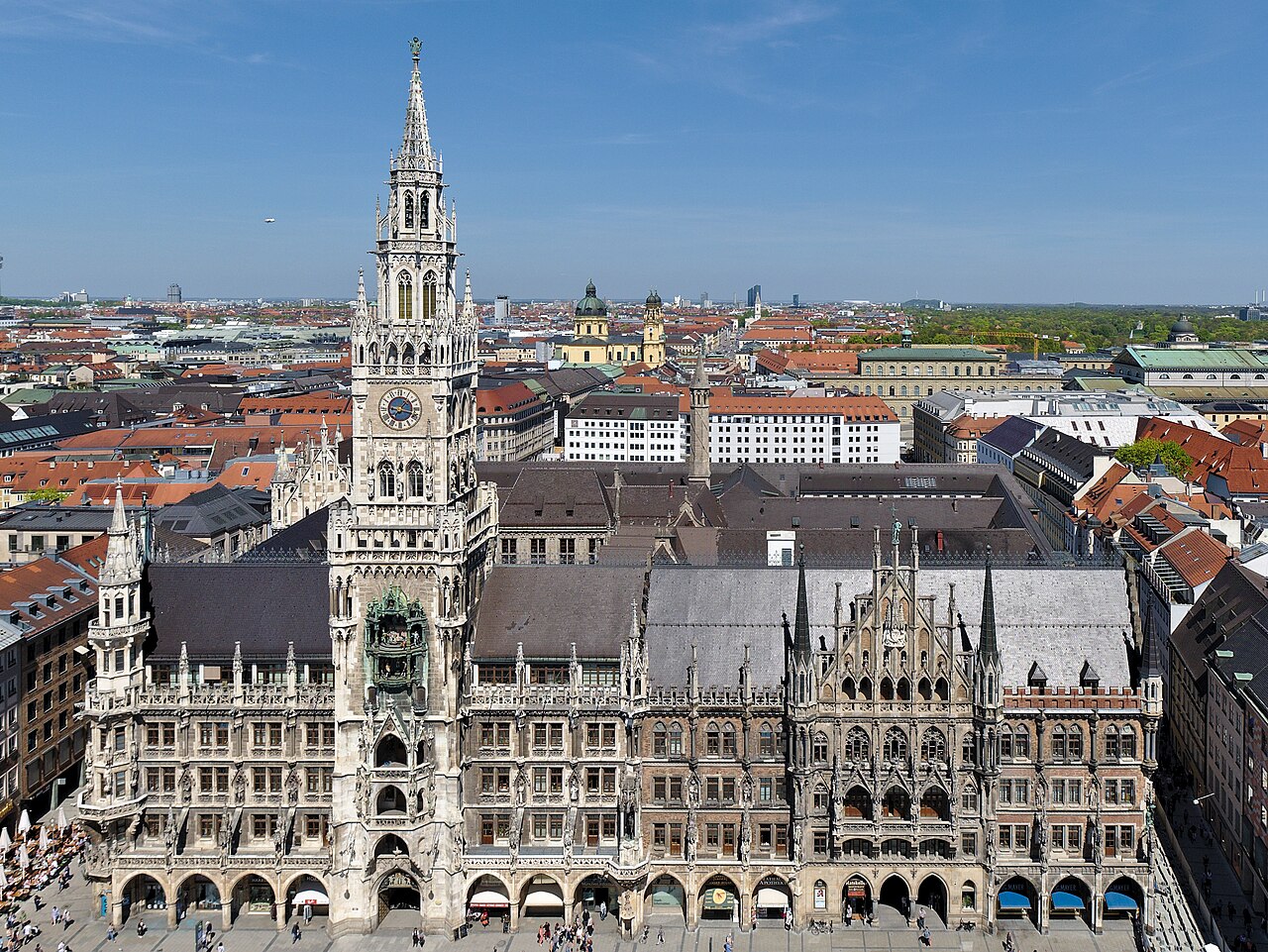
The construction of the Neues Rathaus (New Town Hall) was not an architectural project; it was a financial siege laid by the municipal government against its own treasury. Between 1867 and 1909, the Munich magistrate presided over a forty-year campaign of demolition, land acquisition, and spiraling costs that fundamentally altered the city's fiscal and physical. The driving force was a desperate need for space, yet the result was a monument to civic vanity that pushed the city's credit to its breaking point.
By the mid-19th century, the Altes Rathaus had become a bureaucratic asphyxiation hazard. The city's administration, swelling with the population boom of the industrial age, could no longer function within the medieval confines of the old hall. In 1865, the magistrate made the irrevocable decision to build a new seat of power. The site chosen was the northern flank of Marienplatz, a decision that necessitated the destruction of the historic Landschaftshäuser. These buildings, which had served as the assembly hall for the Bavarian Estates since the 16th century, were leveled in 1865 and 1867. Their demolition erased a tangible link to Bavaria's parliamentary history to make way for a neo-Gothic colossus.
The architectural commission was awarded to Georg von Hauberrisser, a twenty-five-year-old student from Graz who had never built a major public structure. His selection was a gamble that baffled the establishment. Hauberrisser rejected the local "Munich Style" of Maximilianstraße, opting instead for a Flemish Gothic design that borrowed heavily from the town halls of Brussels and Vienna. This was a calculated political statement: the Gothic style symbolized the medieval independence of the burghers, a direct visual challenge to the Italianate and neoclassical palaces of the Wittelsbach monarchy.
Construction proceeded in three distinct, agonizingly expensive phases. The phase (1867, 1874) focused on the eastern wing along Dienerstraße. It was a fiscal disaster. The original budget was set at 550, 000 Gulden. By the time the brick-and-limestone structure was completed, the costs had exploded to over 2. 7 million Marks. This overrun, nearly ten times the initial estimate when adjusted for currency reforms, exposed a serious absence of oversight in the municipal planning office. The use of brick for this section was later viewed as a mistake, leading to a shift in materials for the subsequent expansions.
The city's hunger for land drove the second and third phases. To expand the footprint, the municipality was forced to purchase and demolish twenty-four additional residential and commercial properties along Weinstraße and Landschaftstraße. The records from 1887 show the city paying premium prices for these lots: 225, 000 Marks for the Dallmaier house and 180, 000 Marks for the Jochner property. These acquisitions were funded through municipal bonds that saddled the city with long-term interest payments, a fact frequently omitted from the celebratory guidebooks of the era.
The third phase (1898, 1905) was the most ambitious and the most expensive. It added the western wing and the iconic 85-meter tower. Hauberrisser, a seasoned architect, abandoned the brick of the phase for a facade entirely of Muschelkalk (shell limestone), creating a visual that remains visible today. The tower's construction required deep foundation work that disrupted the square for years. By the time the final stone was laid in 1909, the total direct construction cost, excluding land acquisition, had reached 9, 504, 497 Marks. To put this figure in perspective, it rivaled the military expenditures of small principalities.
| Phase | Period | Key Activity | Recorded Cost / Value |
|---|---|---|---|
| Phase I | 1867, 1874 | East Wing Construction | 2, 722, 654 Marks (approx.) |
| Land Acquisition | 1887 | Purchase of Dallmaier House | 225, 000 Marks |
| Land Acquisition | 1887 | Purchase of Jochner House | 180, 000 Marks |
| Glockenspiel | 1904, 1908 | 43 Bells & method | 154, 000 Marks |
| Total Project | 1867, 1909 | Construction & Furnishing | ~9, 504, 497 Marks |
The Glockenspiel, a tourist magnet, was itself a source of financial complexity. The method and its 43 bells cost 154, 000 Marks. of this, 32, 000 Marks, was donated in 1904 by Karl Rosipal, a wealthy furniture manufacturer, to mark his firm's centennial. The city accepted the money with gratitude, only to refund it to his family in 1933 in an act of anti-Semitic erasure, as Rosipal was of Jewish descent. This refund, though occurring later, show the transactional nature of the building's financing, every stone and bell had a price, frequently paid in social capital as well as currency.
The completion of the Neues Rathaus in 1909 marked the end of the "Schrannenplatz" era in spirit, if not yet in name. The grain market had been banished to the glass palace of the Schrannenhalle in 1853, and the new town hall dominated the square, casting a literal and metaphorical shadow over the older, smaller structures. The debt incurred to build it constrained the municipal budget for decades, limiting investment in sewage and housing infrastructure in the working-class suburbs. The Neues Rathaus was a triumph of bourgeois representation, it was built on a foundation of public debt that the citizens of Munich would service well into the 20th century.
Third Reich Propaganda Events and 1945 Bombing Destruction

The transformation of Marienplatz from a civic market to a stage for totalitarian theater began promptly in 1933. The National Socialists, obsessed with the optics of power, Munich the "Capital of the Movement" and turned its central square into a backdrop for ideological projection. The New Town Hall, once a symbol of bourgeois pride, was draped in swastika banners that hung like vertical scars down its neo-Gothic facade. This was not occupation; it was a repurposing of the city's heart. The square became the focal point for the regime's pseudo-religious calendar, hosting rallies that demanded absolute submission. The most consequential of these events, yet, took place not outdoors, inside the Grand Hall of the Old Town Hall (Altes Rathaus) on the square's eastern edge.
On the night of November 9, 1938, the Nazi leadership gathered in the Altes Rathaus for a "comradeship evening." It was here, in the very seat of municipal governance, that Joseph Goebbels delivered the venomous speech that launched the Kristallnacht pogroms. He instructed the assembled party leaders that "spontaneous" violent uprisings against Jews were not to be discouraged. The orders radiated outward from Marienplatz to the rest of the Reich, turning the city center into the command post for a nationwide atrocity. The violence that night shattered the illusion of civilized order that the square's architecture was meant to project, marking the point where Munich's civic space was fully weaponized against its own citizens.
Retribution arrived from the air. Between 1944 and 1945, Allied bombers dismantled the city with systematic fury. Marienplatz, as the symbolic center, lay directly in the crosshairs. The raid on April 24, 1944, by the USAAF and the RAF delivered a crushing blow, the destruction continued through January 1945. High explosives and incendiaries turned the medieval streets into firestorms. The Old Town Hall, the site of Goebbels' instigation, was nearly obliterated; its tower was severed, blown apart to prevent its collapse onto the street. The New Town Hall suffered heavy damage, its intricate stone lace smashed into the pavement. By the end of the war, approximately ninety percent of the historic Altstadt was in ruins. The logistical engine of the city had become a necropolis of masonry.
On April 30, 1945, the silence of "Hour Zero" fell over the square. Soldiers of the U. S. Army's 42nd "Rainbow" Division arrived to find a of jagged walls and mountains of debris. Yet, amidst the total devastation, the Mariensäule remained standing. The golden statue of the Virgin Mary, erected in 1638 to commemorate survival from an earlier war, rose unscathed above the sea of rubble. This survival offered a clear, almost surreal counterpoint to the destruction surrounding it. The Nazi "Capital of the Movement" had been reduced to a hollow shell, its monuments broken, its ideology bankrupt, leaving only the original patron of the square watching over the wreckage.
Post-War Rubble Clearance and Reconstruction Costs 1946, 1960
The silence that fell over Marienplatz in May 1945 was as heavy as the five million cubic meters of debris that choked the city. For the time in centuries, the square was not a market, a parade ground, or a transit hub. It was a graveyard of masonry. Allied bombing raids, specifically the seventy-one air strikes that targeted Munich between 1940 and 1945, had reduced ninety percent of the historic Altstadt to a jagged topography of ruins. The heart of the city did not beat; it barely breathed under a suffocating blanket of pulverized brick and twisted steel. The immediate post-war reality was not one of reconstruction, of excavation. The square had to be dug out before it could be rebuilt.
The logistics of this clearance were military in. The rubble did not simply; it was migrated. In the immediate aftermath, the US Army cleared main arteries for transport, the granular removal of the city's destroyed skeleton fell to the population. On October 29, 1949, Mayor Thomas Wimmer initiated the "Rama Dama" (Bavarian for "Let's clean up"), a mass mobilization of citizens armed with shovels. While later historical analysis suggests the "Trümmerfrauen" (rubble women) narrative was amplified for social cohesion, the physical labor on Marienplatz was undeniably manual and exhausting. Narrow-gauge rubble trains, known as Bockerl, ran through the streets, hauling the debris of the city center to the outskirts. The wreckage of the medieval and neo-gothic structures that once defined the square forms the foundation of the Olympiaberg, a literal mountain of war waste that rises above the modern city.
The decision of what to build on this cleared land was far more contentious than the removal of the ruins. In 1946, the city architect Karl Meitinger presented "Das Neue München" (The New Munich), a planning document that would determine the visual fate of Marienplatz. The modernist faction argued for a "tabula rasa," a complete erasure of the old crooked streets in favor of a car-centric grid that would have turned Marienplatz into a high-speed traffic intersection. Meitinger fought for the "conservative reconstruction" model. His plan preserved the historic footprint of the streets and the volume of the buildings, even if the interiors were modern concrete shells. Marienplatz remained a square, not a highway interchange, a decision that saved the spatial identity of Munich.
The Neues Rathaus, the neo-gothic colossus that dominates the northern flank, had survived with "light" damage compared to its neighbors. Its roof was shattered, and the facade was scarred by shrapnel, the structural integrity held. Restoration began almost immediately, driven by the administrative need to have a functioning seat of government. By the early 1950s, the glockenspiel was operational again, its mechanical figures dancing over a square that was still largely a construction site. The restoration of the Neues Rathaus was a psychological signal: the authority of the city had returned.
The Altes Rathaus, guarding the eastern gate, fared far worse. A bomb had severed its connection to the square, and the main tower was structurally compromised. For decades, the building stood as a truncated stump. While the Great Hall was restored between 1953 and 1958 to host city council festivities, the iconic tower that defines the skyline was absent. It was not rebuilt until the 1970s. Throughout the 1950s, the view east from the Marian Column was a view of a gap, a missing tooth in the architectural smile of the city. This absence served as a daily reminder of the war's cost, even as the "Economic Miracle" began to fill the shop windows.
The most dramatic near-loss was St. Peter's Church (Alter Peter), the oldest parish church in Munich, looming just behind Marienplatz. The damage was so catastrophic that demolition orders were drafted. Engineers had already drilled holes into the remaining walls for dynamite charges. The church was saved not by city planning, by a desperate intervention from Michael Cardinal von Faulhaber and a furious public fundraising campaign. The reconstruction of Alter Peter became a proxy for the reconstruction of Bavarian identity. It was funded by the "Bavarian Radio Lottery" and private donations, a financial mobilization that allowed the reconstruction to begin in 1946. By 1951, the shell was closed. By 1960, the tower was accessible again, allowing citizens to look down on a Marienplatz that was rising from its own ashes.
| Metric | Data Point |
|---|---|
| Total Rubble Volume | ~5, 000, 000 cubic meters (city-wide) |
| Altstadt Destruction | ~90% of buildings severely damaged or destroyed |
| Rubble Destination | Olympiaberg, Luitpoldpark, Neuhofener Berg |
| Rama Dama Date | October 29, 1949 |
| Key Architect | Karl Meitinger (Conservative Reconstruction) |
| Currency Reform | June 1948 (Reichsmark to Deutschmark) |
| Target Deadline | 1958 (800th City Anniversary) |
The economics of this reconstruction were bifurcated by the Currency Reform of June 1948. Before this date, reconstruction was slow, by the worthlessness of the Reichsmark and the black market economy. Materials were scavenged or bartered. After the introduction of the Deutschmark, the speed of construction on Marienplatz accelerated violently. Capital flooded back into the city. The commercial buildings lining the south side of the square were rebuilt with speed and profit in mind, frequently resulting in simplified, functionalist facades that mimicked the of their predecessors absence their ornamentation. This period cemented the "Munich Consensus": a historic mask worn by a modern commercial engine.
The deadline that drove the final phase of this era was 1958, the city's 800th anniversary. City officials were desperate to present a completed Marienplatz to the world. Scaffolding was rushed down; facades were painted. When the celebrations began, the square appeared whole. The scars on the Neues Rathaus were smoothed over, the pavement was relaid, and the market activity had returned. Yet, this completeness was partially an illusion. Behind the fresh stucco, the city was still stitching itself together. The Altes Rathaus remained towerless, and the scars of shrapnel were still visible on the stone of the lower arches, deliberately left by architects as a "memento mori."
By 1960, Marienplatz had successfully transitioned from a ruin to a reconstructed urban center. The cost was astronomical, funded by a mix of Marshall Plan aid, state lotteries, and tax revenues from the booming post-war economy. The square that emerged was a hybrid: it possessed the soul of the 19th century the bones of the 20th. It was no longer the gritty grain market of the 1700s, nor the parade ground of the Third Reich. It had become the polished, commercial, and ceremonial stage for a democratic Munich, built on a foundation of debris that had been meticulously cleared by the hands of its own citizens.
1972 Olympic Pedestrianization and Subway Engineering

By the late 1950s, Marienplatz had ceased to be a civic plaza and had devolved into a diesel-choked traffic knot. Post-war reconstruction, while faithful to the city's medieval footprint, had surrendered the ground level to the automobile. Trams rattled through the square, their steel wheels screeching against curved rails, while a relentless procession of Volkswagen Beetles, delivery trucks, and buses wove through the narrow gap between the New Town Hall and the commercial buildings on the south side. Data from the Munich planning department in the mid-1960s recorded traffic volumes exceeding 75, 000 vehicles daily traversing the Kaufingerstraße-Marienplatz-Tal axis. The "heart of the city" was a glorified roundabout, hostile to pedestrians and deafening to anyone attempting conversation.
The catalyst for exorcising the combustion engine from Marienplatz was the International Olympic Committee's decision in 1966 to award Munich the 1972 Summer Games. The deadline was absolute. In less than six years, the city had to execute the "Golden Plan" of 1963, a theoretical infrastructure roadmap that suddenly required concrete reality. The engineering challenge was twofold: construct a high-capacity subterranean transit hub to move millions of spectators, and simultaneously reclaim the surface for human use. The result was a construction project of such violence and that it was dubbed the "construction site of the century," turning the city center into an open wound of mud, steel, and concrete for nearly five years.
The engineering beneath Marienplatz required a vertical complexity previously unknown in Bavarian construction. The station was designed as a four-level subterranean cathedral, a structural lattice inserted delicately beneath the foundations of the neo-Gothic New Town Hall. The design prioritized throughput, anticipating the crush of Olympic crowds. The solution adopted was the "Spanish Solution" (Spanische Lösung), a platform arrangement where passengers board from a central island and exit onto side platforms, separating conflicting flows of human traffic. This method, borrowed from the Barcelona Metro, was applied to the S-Bahn levels to ensure that dwell times remained minimal during peak Olympic traffic.
The excavation sliced through the city's geology, navigating the Munich gravel plain and the underlying "Flinz" (tertiary marl). The station layout was stacked with ruthless efficiency:
| Level 1 | Mezzanine (Sperrengeschoss) | Retail, ticket halls, and distribution nodes. |
| Level 2 | S-Bahn (Eastbound) | Lines S1, S8 towards Ostbahnhof. Spanish Solution platforms. |
| Level 3 | S-Bahn (Westbound) | Lines S1, S8 towards Hauptbahnhof. Spanish Solution platforms. |
| Level 4 | U-Bahn (North-South) | Lines U3/U6. Deepest level, crossing beneath the S-Bahn trunk. |
The U-Bahn lines, specifically the U3 and U6, were positioned at the deepest level, Level 4, requiring passengers to descend through the S-Bahn strata. The U6 line opened, in October 1971, followed by the S-Bahn trunk line and the U3 in May 1972, just weeks before the opening ceremony. The sheer volume of earth removed was, and the hydrogeological risks were high; the water table in the Munich gravel had to be managed aggressively to prevent the historic Rathaus from settling or cracking. The station's interior aesthetic defined the era: bright orange and blue ceramic tiles, brushed aluminum, and a lighting concept designed to banish the subterranean gloom, a deliberate contrast to the dark, oppressive bunkers of the recent wartime past.
While the engineers hollowed out the underground, the surface was reimagined by architect Bernhard Winkler. His victory in the design competition signaled a radical departure from the car-centric urbanism of the 1950s. Winkler's vision for the pedestrian zone (Fußgängerzone) was not to ban cars to furnish the city as a "public living room." He designed custom street furniture, including the -iconic "Munich City Chair," and specified paving patterns that used granite slabs to unify the architectural styles of the square. The design emphasized openness, removing the curbs and sidewalks to create a single, level plane that stretched from Karlsplatz (Stachus) to Marienplatz.
The transformation was formalized on June 30, 1972. At 10: 00 AM, the blocks were lifted, and the pedestrian zone in Germany of this was inaugurated. The silence was the thing residents noticed; the roar of engines was replaced by the murmur of footsteps and conversation. Retailers who had fiercely opposed the plan, fearing that the absence of drive-up traffic would kill business, saw their turnover explode. Marienplatz became the undisputed commercial and social well of the city. The pedestrianization was not just an urban planning success; it was a psychological reset for Munich, presenting a face of "cheerful games" and liberal openness to the world.
The legacy of 1972 remains the operating system of Marienplatz in 2026. The station handles over 175, 000 passengers daily, pushing the 1970s infrastructure to its breaking point. To alleviate this, a massive expansion was undertaken between 2003 and 2006, where additional pedestrian tunnels were mined using liquid nitrogen soil-freezing techniques to stabilize the ground, a high-tech echo of the original engineering daring. Today, the square faces a new pattern of excavation. The "Second S-Bahn Trunk Route" (Zweite Stammstrecke) is currently being bored even deeper into the earth, with the new Marienhof station under construction just north of the square. This project, digging down to 40 meters, represents the generational of engineering, destined to join the 1972 lattice in the subterranean history of Munich.
Glockenspiel Mechanical Failures and Restoration Logs
| Component | Action Taken | Technical Note |
|---|---|---|
| Bells (43 Units) | Removal and Cleaning | Bells were lowered from the tower. Accumulated corrosion and bird waste removed to restore acoustic clarity. |
| Bell Holder | Replacement | Original steel suspension showed signs of fatigue. Replaced with high-grade stainless steel to prevent catastrophic failure. |
| Springs and Cables | Full Replacement | Tension springs had lost elasticity. Steel cables showed fraying. All kinematic links were swapped for modern alloys. |
| Tuning | Acoustic Calibration | Bells were re-tuned. Post-installation reports indicated the sound was initially "out of tune" before final adjustments. |
| Figures (32 Units) | Surface Restoration | Copper skins were cleaned and repainted. Hinges and pivot points were lubricated with synthetic grease. |
The 2007 restoration revealed the extent of the wear. The bell holder suspension was near failure. If it had snapped, 7, 000 kilograms of bronze would have crashed through the tower structure. The restoration team replaced the suspension with stainless steel. They removed every bell. They cleaned the bronze skins of the figures. The "Schäfflertanz" dancers and the jousting knights were lowered to the ground for the time in decades. Even with this overhaul, the Glockenspiel remains a high-maintenance device. It is not fully automatic. It is a semi-automated system that requires daily human intervention. A control room on the fifth floor houses the levers. A human operator must engage the method 364 days a year. The only day of silence is Good Friday. The operator triggers the joust. The operator triggers the coopers' dance. The operator triggers the rooster. The rooster is a frequent point of failure. This small golden figure at the apex of the stage must flap its wings and crow three times to conclude the show. The sound is produced by a bellows method. The bellows are made of leather and wood. They are susceptible to dry rot and cracking. When the bellows fail, the rooster opens its beak emits no sound. This "mute rooster" error is a common entry in the maintenance logs. The wing-flapping method also jams. A small gear strips or a linkage binds. The bird stands frozen while the crowd waits for a signal that never comes. The energy source for this spectacle has shifted. The modern Glockenspiel is powered by solar energy. Photovoltaic panels on the roof of the New Town Hall feed the electrical grid that drives the motor. This is a 21st-century retrofit of a 20th-century machine depicting 16th-century events. The solar conversion reduces the carbon footprint of the performance. It does not reduce the mechanical complexity. The gears still grind. The chains still stretch. The year 2026 holds specific significance for the content of the Glockenspiel. The lower tier of the machine depicts the Schäfflertanz. This is the Coopers' Dance. Legend states that in 1517, after a plague, the barrel makers danced in the streets to show the frightened populace that the air was safe. This dance is performed by real humans in Munich only once every seven years. The year 2026 is a Schäffler year. The mechanical dancers in the tower be mirrored by flesh-and-blood dancers on the pavement. This synchronization of the model and the reality occurs rarely. The maintenance teams operate with a philosophy of "error culture." They expect breakdowns. They use the daily malfunctions to train new staff. A jammed knight is not a emergency. It is a lesson in the kinematics of the tower. The operator must know how to manually reset the figures. They must know how to climb into the narrow maintenance shafts to grease a stuck bearing. The figures are exposed to the elements. Wind drives rain into the housing. Frost seizes the pivots. The summer sun expands the metal tracks. The machine fights the weather every day. The music itself is subject to mechanical limitation. The cylinder plays four melodies. These change monthly. The repertoire includes folk songs and drinking songs. The pins on the cylinder wear down over time. The hammers that strike the bells suffer from metal fatigue. A missed note in the melody is frequently the sign that a spring has snapped or a pin has bent. The acoustic audit is part of the daily routine. The operator listens for the missing note. The Glockenspiel is a facade of joy built on a skeleton of steel and grease. It requires constant capital and labor to function. The 750, 000 Euro restoration in 2007 was a temporary fix in the lifespan of the city. The rust return. The leather of the rooster's bellows crack again. The cables stretch. The machine demands attention. It is a relentless consumer of maintenance budget. It serves as a reminder that even the most whimsical traditions in Munich are sustained by hard engineering and cold cash. The knight wins only because the gears allow him to win. The rooster crows only if the leather holds.
Commercial Real Estate Valuation and Tenant Turnover 2000, 2023
Commercial real estate valuations in Marienplatz and the adjacent Kaufingerstraße consistently ranked as the highest in Germany between 2000 and 2023. Market data from JLL and local brokerage firms places prime retail rents in this specific zone at approximately 300 to 360 euros per square meter monthly by the end of the period. This pricing structure contradicts the broader decline in brick-and-mortar retail performance seen elsewhere in Europe. Property owners extract these premium rates even as the underlying economics of physical stores deteriorate. The disconnect between asking prices and retailer profitability forced a transformation of the tenant mix, pushing out lower-margin businesses in favor of global chains and luxury conglomerates capable of absorbing the cost.
The insolvency of Signa Holding in late 2023 exposed the fragility of the ownership structures controlling these prime assets. René Benko's real estate empire, which held the Galeria Karstadt Kaufhof building on the square and the nearby Alte Akademie project, collapsed under billions in debt. This financial failure placed of Munich's most valuable commercial square footage into legal uncertainty. While the Galeria department store at Marienplatz survived the closure waves of 2023 and 2024 that claimed other locations, the bankruptcy of its parent company revealed the volatile use supporting these high-street valuations.
Long-standing Munich institutions have had to restructure their physical footprint to survive this rent load. Hugendubel, the city's premier bookseller, could not sustain its massive standalone presence directly on the square. The company downsized its flagship store between 2016 and 2017, ceding valuable ground-floor space to Deutsche Telekom. This move signaled a shift where even heritage brands must dilute their occupancy or sublet prime frontage to telecommunications or technology giants to justify the expense. The era of the single-tenant, multi-story local retailer has largely ended in this district.
Footfall statistics from the ifo Institute indicate that consumer traffic in Munich's city center in 2023 remained approximately 5 percent 2019 levels. This reduction even with the end of pandemic restrictions. Shoppers direct more spending toward online channels or residential suburbs, creating a "donut effect" that hollows out the traditional dominance of the central business district. even with this measurable drop in chance customers, commercial rents in Marienplatz have not adjusted downward, creating a bubble where valuation ignores the reduced density of shoppers.
Terrorism Defense Measures and Concrete Barrier Installation 2016, 2025
Table: Marienplatz Security Infrastructure Evolution (2015, 2026)
| Era | Primary Defense | Surveillance Status | Access Control |
|---|---|---|---|
| Pre-2016 | Police Patrols | Standard CCTV | Open / Traffic Bollards |
| 2016, 2017 | "Nizza-Sperren" (Concrete Blocks) | Enhanced CCTV | Physical Blockade (Static) |
| 2018, 2022 | Retractable Bollards / Planters | HD PTZ Integration | Remote Controlled / Selective |
| 2023, 2026 | Integrated "Munich Model" | Mobile Video Towers / AI Trials | Biometric / Weapons Ban Zone |
The " " strategy has succeeded in its primary metric: there has been no successful vehicle-ramming attack on Marienplatz since the measures were implemented. Yet, the cost is a subtle of the square's character. The open, chaotic flow of the 18th-century Schrannenplatz has been replaced by a filtered, monitored, and engineered flow. The blocks are, they are a constant physical reminder that the square is a target, and that the safety of the crowd is maintained only by the strength of the steel beneath their feet.
Nitrogen Dioxide Levels and Green Zone Enforcement 2018, 2026

The air above Marienplatz, invisible and odorless, became the primary battleground for Munich's urban planning policy between 2018 and 2026. While the cobblestones of the square had been scrubbed of the horse manure that defined the 18th-century Schrannenplatz, the 21st-century atmosphere carried a more insidious toxic load: nitrogen dioxide (NO2). This gaseous pollutant, a byproduct of high-compression internal combustion engines, did not blacken facades like the coal soot of the industrial age, yet it attacked the respiratory systems of the populace with far greater efficiency. The struggle to purge this compound from the city center transformed the administrative map of Munich, turning the Altstadt into a of regulated access.
By 2018, the situation had become legally untenable. The European Union limit for annual mean NO2 concentration stood at 40 micrograms per cubic meter (µg/m³), a threshold Munich frequently violated. Measurement stations at Landshuter Allee and Stachus, the latter sitting just 300 meters from Marienplatz, recorded levels that drew the ire of environmental watchdogs. The Deutsche Umwelthilfe (DUH), a relentless non-governmental organization, launched a series of lawsuits that forced the hand of the Bavarian state government. These legal actions culminated in a high- standoff where the Bavarian Administrative Court threatened high-ranking officials, including the Environment Minister, with "Zwangshaft" (coercive detention) for their refusal to implement clean air plans. The political theater was intense, yet the chemistry of the air remained stubborn.
The city administration, led by Lord Mayor Dieter Reiter, faced a binary choice: ban the diesel engine or face federal intervention. They chose a tiered prohibition strategy. On February 1, 2023, the expanded "Umweltzone" (Green Zone) went into effect. This regulatory cordon, which previously covered only the area inside the Mittlerer Ring, was tightened to include the ring road itself, a major artery that funnels traffic around the historic core. The new rules were explicit. Diesel vehicles meeting only Euro 4 emissions standards or worse were barred from entry. This affected roughly 70, 000 registered vehicles in Munich and commuters from the surrounding agrarian hinterland, echoing the friction between city and country that existed when grain carts clogged Schrannenplatz three centuries prior.
Enforcement of these zones relied on a mix of random police checkpoints and the threat of heavy fines. Unlike the public executions of the 1700s which relied on visual terror to enforce order, the diesel ban operated through bureaucratic attrition. A violation carried a fine of 100 euros plus administrative fees. The police did not use automated license plate recognition cameras, citing privacy laws, which meant the "Green Zone" relied heavily on the honor system and the occasional patrol. Even with this analog enforcement method, the psychological impact on the driving public was immediate. The resale value of older diesel cars plummeted, and the composition of traffic on the Tal and Sendlinger Straße began to shift.
The following table outlines the escalation of regulatory measures and the corresponding nitrogen dioxide levels recorded at the Stachus measurement station, a proxy for the air quality drifting into the pedestrianized Marienplatz.
| Year | Regulatory Action / Event | Stachus NO2 Level (µg/m³) | Status vs. EU Limit (40 µg/m³) |
|---|---|---|---|
| 2018 | DUH Lawsuits Intensify | 46 | Violation |
| 2019 | Diesel Ban Discussions | 42 | Violation |
| 2020 | COVID-19 Lockdowns | 33 | Compliant (Anomaly) |
| 2021 | Traffic Returns | 35 | Compliant |
| 2022 | Pre-Ban Anticipation | 38 | Borderline |
| 2023 | Stage 1 Ban (Euro 4) Active | 36 | Compliant |
| 2024 | Stage 2 (Euro 5) Suspended | 34 | Compliant |
| 2025 | Updated Air Quality Plan | 31 | Compliant |
The anticipated "Stage 2" of the ban, scheduled for October 2023, promised to exclude Euro 5 diesel vehicles. This would have been a radical escalation, affecting a much larger slice of the suburban fleet. Yet, the data provided an off-ramp for the politicians. As the table shows, NO2 levels at Stachus and other key monitoring points dropped the 40 µg/m³ limit during the half of 2023. The city council, seizing on these metrics, suspended the tightening of the ban. Critics argued that the drop was due to favorable weather conditions and the lingering effects of remote work, not the Euro 4 ban itself. A study by Ludwig Maximilian University later confirmed that the specific impact of the ban was "small," reducing concentrations by only about 2 to 3 µg/m³. The heavy lifting was likely done by the natural turnover of the vehicle fleet, drivers replacing old cars with cleaner models over time.
Inside Marienplatz itself, the pedestrian status offered no immunity from the surrounding chemical soup. Air masses are fluid; the pollution generated on the Altstadtring drifts into the square. also, the "pedestrian" zone is a legal fiction during certain hours. Between 6: 00 AM and 10: 00 AM, the square functions as a logistics terminal. Delivery vans, powered by diesel engines to maximize torque for heavy loads, idle outside the department stores and cafes. These vehicles, technically exempt or operating under special permits, create localized spikes in NO2 that daily averages frequently smooth over. The "Lieferverkehr" (delivery traffic) remained the Achilles' heel of the clean air strategy. While the private car was banished, the commercial van remained a necessary evil to keep the retail heart of the city beating.
By 2025, the conversation shifted from the EU limit of 40 µg/m³ to the World Health Organization's far stricter recommendation of 10 µg/m³. Under this new lens, Munich's air remained dangerously polluted. The "success" of 2023 was a compliance with outdated standards. Medical consensus in 2026 held that there is no safe level of nitrogen dioxide exposure. The invisible gas continued to inflame the lining of lungs and increase the risk of stroke for the tourists admiring the Glockenspiel. The city began piloting "micro-hubs" on the outskirts, where goods would be transferred from diesel trucks to electric cargo bikes for the final mile into Marienplatz. This marked a return to the logistics of the 1700s, human power replacing horsepower, with lithium-ion batteries instead of muscle.
The enforcement of the Green Zone also revealed a socioeconomic divide. The wealthy residents of the Lehel and Maxvorstadt could easily afford compliant electric or gasoline vehicles. The working-class commuters from the outer districts, who relied on older, fuel- diesels to navigate the sprawling geography of Bavaria, bore the brunt of the restrictions. The "Blue Zone" (a proposed stricter ban area) became a symbol of this. While it was never fully implemented in its most draconian form, the threat of it accelerated the gentrification of the vehicle fleet. By 2026, the streets around Marienplatz were dominated by high-end electric SUVs and commercial delivery drones, a sanitized terrain where the right to pollute was determined by the ability to pay for cleaner technology.
The historical irony is sharp. In 1853, the grain market was moved from Schrannenplatz to the glass-and-iron Schrannenhalle to sanitize the trade and remove the filth of the horses. In 2023, the city attempted a similar sanitization, not by moving the market, by filtering the machines that serviced it. The result was a Marienplatz that appeared pristine to the eye remained chemically complex to the sensor. The nitrogen dioxide levels, while lower than the peak years of the diesel boom, served as a reminder that a city of 1. 5 million people cannot exist without metabolic waste. The waste had simply shifted from the solid manure of the 18th century to the gaseous exhaust of the 21st.
FC Bayern Title Celebrations and Public Safety Incidents
The modern identity of Marienplatz is inextricably bound to the rituals of FC Bayern München. Since the late 20th century, the "Meisterfeier" (championship celebration) has transformed the square from a civic hub into a red-and-white amphitheater of football worship. This tradition centers on the balcony of the New Town Hall, where players present the Meisterschale (championship shield) to a sea of supporters. The event is not a party; it is a logistical operation of military precision, requiring the coordination of police, private security, and city officials to manage crowds that frequently exceed the square's safe capacity.
The trajectory of these celebrations offers a timeline of the city's recent social history. In the pandemic years of 2020 and 2021, the balcony remained empty, the square silent, a clear visual representation of the lockdown era. The tradition resumed in 2022 with the club's tenth consecutive Bundesliga title, the shifted in 2024. For the time in over a decade, the men's team failed to secure the league trophy, surrendering dominance to Bayer Leverkusen. Yet, the balcony was not abandoned. On May 20, 2024, the FC Bayern Women's team, having secured their own championship, took sole possession of the stage. This moment marked a significant deviation from the male-centric norm, as thousands gathered specifically to honor the women's squad, signaling a changing cultural in Munich's sports fandom.
By May 2025, the dual-celebration model had solidified. Under head coach Vincent Kompany, the men's team reclaimed the Bundesliga title, while the women's team secured a domestic double. On May 18, 2025, approximately 18, 000 fans packed the square to witness the joint festivities. The event also served as a public farewell for club legend Thomas Müller, whose departure turned the celebration into a nostalgic civic ceremony. The logistics of this 2025 event were immense: a strict "Glasverbot" (glass ban) was enforced within a 300-meter radius, and U-Bahn exits at Rindermarkt and Fischbrunnen were sealed to prevent dangerous overcrowding in the station.
The financial load of these spectacles has become a matter of contentious public debate. Data from the city council reveals a sharp escalation in security costs. In 2019, the city spent approximately €402, 290 to secure the event. By 2025, this figure had risen to nearly €500, 000. While the city government views this as a necessary expenditure for a global brand ambassador, opposition factions have argued that a club with billion-euro revenues should shoulder the entire bill for its private parties. The cost includes not just police overtime the deployment of heavy mobile blocks, a response to the evolving threat of European public gatherings.
Public safety on Marienplatz has not always been a matter of celebratory crowd control. The square has been the site of acute panic and state-sanctioned violence. On July 22, 2016, following a shooting at the Olympia-Einkaufszentrum (OEZ) in the Moosach district, mass hysteria gripped the city center. False reports of a second attack at Stachus and Marienplatz triggered a stampede. Hundreds of diners and pedestrians fled across the square in terror, overturning tables and trampling others in a desperate bid to find cover in the Rathaus and nearby department stores. The incident exposed the fragility of public order in high-density urban spaces, leading to a permanent revision of police emergency for the city center.
Deeper in the historical record, the square served as the launchpad for one of the 20th century's darkest chapters. On November 9, 1938, in the Grand Hall of the Old Town Hall (Altes Rathaus) on the eastern edge of Marienplatz, Nazi propaganda minister Joseph Goebbels delivered the speech that instigated Kristallnacht (the Night of Broken Glass). His words, spoken just meters from the Marian Column, unleashed a wave of pogroms across the Reich. While modern safety concerns focus on crush loads and pyrotechnics, this event remains the single most catastrophic "public safety" failure in the square's history, a moment where the state itself turned the city center into an engine of terror.
| Date | Event | Est. Crowd | Key Incident / Metric |
|---|---|---|---|
| July 22, 2016 | OEZ Aftermath Panic | Transient | Mass stampede due to false shooter reports; multiple injuries from trampling. |
| May 2019 | FC Bayern Celebration | 15, 000+ | Security cost to city: €402, 290. |
| May 2020 | COVID-19 Lockdown | 0 | Square empty; cancelled celebration in decades. |
| May 20, 2024 | FC Bayern Women Title | Thousands | exclusive women's team balcony celebration. |
| May 18, 2025 | Joint Title Party | 18, 000 | Security cost ~€500, 000; strict glass ban; U-Bahn station closures. |
Fischbrunnen Water Systems and Butcher's Leap Tradition
The history of the Fischbrunnen is not a chronicle of decorative masonry a timeline of Munich's hydro-engineering maturity and its stubborn adherence to guild rituals that modern sanitation norms. While the Marienplatz of 2026 serves as a digital backdrop for global tourism, the fountain at its northeast corner remains a functional artifact of the city's biological and civic survival, rooted in the water tables of the Middle Ages and the cholera fears of the 19th century.
In the early 1700s, the water sources on Schrannenplatz were strictly utilitarian. The city sat atop a shallow groundwater table, allowing for dug-out wells that were prone to contamination from the very market waste they were meant to clean. The "Citizens' Fountain" mentioned in records from 1343 had evolved by the 18th century into a serious node for the fish market, where live catches were kept fresh in submerged baskets. yet, the water quality was frequently suspect. It was not until the mid-19th century that the city's water infrastructure underwent the radical modernization required to support a rapidly densifying population. The turning point arrived with the construction of the Mangfall Valley pipeline. When this high-pressure mountain water system reached the city center, the fountain on Marienplatz was the public outlet connected to it. The engraving "1884" on the current basin does not mark the fountain's construction, rather this hydraulic milestone, the moment Munich's central square was severed from the tainted groundwater and plugged into the pristine reservoirs of the Alps.
The aesthetic transformation of the fountain mirrored this infrastructural upgrade. In 1862, the city commissioned sculptor Konrad Knoll to create a monument befitting the square's rising status. Knoll's design, completed in 1865, was a neo-Gothic bronze complex cast at the Royal Ore Foundry of Ferdinand von Miller. It was a dense, vertical narrative: four butcher apprentices poured water from buckets, four musician children played above them, and a senior journeyman toasted the city from the pinnacle. This structure stood for nearly eighty years, a symbol of the confident, industrializing Bavarian capital. The Allied bombing raids of 1944 obliterated this confidence. The blast reduced Knoll's intricate bronze hierarchy to scrap, leaving only a few figures intact amidst the rubble of the Neues Rathaus.
The reconstruction in 1954 by Josef Henselmann rejected a faithful neo-Gothic restoration in favor of a modernist hybrid that acknowledged the rupture of the war. Henselmann used a basin of Nagelfluh, a conglomerate rock from the northern Alpine foothills, whose turquoise hue under water creates the fountain's distinct, glacial optical quality. He salvaged three of Knoll's original butcher figures, arranging them around a central column topped not by a journeyman, by a bronze fish modeled by his student, Otto Kallenbach. This design choice was a direct nod to the square's pre-1853 identity as a market floor. The result is a jarring synthesis: the 19th-century realism of the butchers juxtaposed with the mid-20th-century abstraction of the basin and fish. In 2011, a detailed renovation resealed the Nagelfluh joints and decalcified the bronzes, ensuring the hydraulic integrity of the system for the generation.
The fountain's water is the medium for the Metzgersprung (Butcher's Leap), a ritual that dates to the aftermath of the plague in 1517. Legend dictates that the butchers' guild, seeking to lure frightened citizens out of their homes, danced through the streets and jumped into the fountain to prove the air and water were safe. Historical analysis suggests the tradition formalized the end of apprenticeship, a baptism washing away the "dust" of training. Banned in 1793 by Elector Karl Theodor due to public disorder, the custom was revived by King Maximilian II in the 19th century and continues to operate on a three-year pattern. The most recent iteration, occurring in September 2025, saw apprentices clad in sheepskins and hung with calves' tails plunge into the 12-degree Celsius water. They splashed the spectators, a crowd of thousands against the blocks, while throwing apples, nuts, and coins. This performance is not a reenactment for tourists a closed-loop guild ceremony that asserts the butchers' continued presence in the city's commercial hierarchy.
| Period | Configuration / Event | Water Source | Significance |
|---|---|---|---|
| 1700, 1862 | Utilitarian Market Wells | Shallow Groundwater | Used for keeping fish catches alive; high contamination risk. |
| 1865, 1944 | Knoll Neo-Gothic Fountain | Mangfall Valley (after 1884) | Monumental bronze design; connection to Alpine spring water. |
| 1944 | Destruction | System Severed | Destroyed by Allied bombing; only 3 figures survived. |
| 1954, Present | Henselmann Reconstruction | Municipal Supply | Modernist Nagelfluh basin; integration of 1865 ruins. |
| 2025 (Sept) | Metzgersprung Ritual | Recycled Fountain Water | Latest occurrence of the triennial apprentice baptism. |
Parallel to the butchers' physical immersion is the fiscal immersion of the Geldbeutelwaschen (Purse Washing). On Ash Wednesday, the Mayor of Munich, accompanied by the city treasurer and club presidents, dips an empty leather purse into the Fischbrunnen. This ritual, formalized in the mid-20th century rooted in 15th-century superstitions, operates on the sympathetic magic principle that washing the wallet attract new wealth. In the lean years following World War II, this gesture carried a heavy, desperate weight. By 2026, it has morphed into a media event, yet the underlying anxiety regarding municipal solvency remains. The image of the Mayor submerging the city's finances in the same water used to cool 19th-century fish stocks connects the modern abstraction of budget deficits to the tangible, cold reality of the Alpine supply.
The engineering beneath the square in 2026 is a far cry from the wooden pipes of the 1700s. The Fischbrunnen is fed by a recirculation system that treats and filters the water to maintain clarity in the Nagelfluh basin, though the source remains the potable municipal supply. The water is safe for the dogs that frequently drink from the lower basin, a deliberate design feature added during the 1991 restoration. In winter, the fountain is frequently boarded up to prevent frost damage to the porous stone and the bronze piping, a seasonal hibernation that renders the square strangely quiet. When active, the sound of the four jets clear the water surface provides a white-noise mask for the conversations of the crowds that gather on the stone rim, maintaining the location's function as a primary meeting point, a "zero mile" for social interaction in the city center.
The survival of the Fischbrunnen is an anomaly. In a city that has aggressively modernized its transit and retail sectors, the persistence of a fountain where apprentices wear animal tails and politicians wash leather wallets suggests a deep, protective conservatism regarding water rituals. The structure is not a piece of street furniture; it is a civic altar. The three bronze butchers, scarred by the 1944 bombing and re-welded by Henselmann, do not just pour water; they recirculate the memory of the city's destruction and its subsequent, stubborn rebirth. As the water pattern through the modern pumps in 2026, it carries the invisible weight of three centuries of market waste, plague fears, and the specific, metallic taste of the Mangfall Valley.